Posts

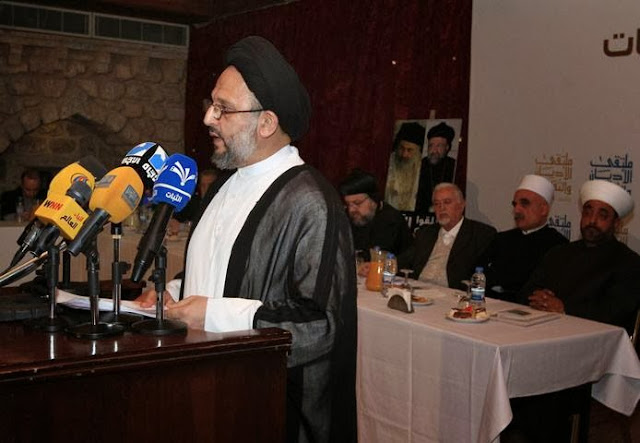
Sayyed Ali Fadlallah launches interfaith initiative to contain extremism and sectarianism
Image
  By Dr. Haytham Mouzahem In 2001, the late Shi’a scholar Grand Ayatollah Sayyed Muhammad Hussein Fadlallah held a group interview with journalists. Fadlallah was a famous cleric in Lebanon and the Arab world and known in the West since October 23, 1983 when a suicide bomber killed 241 Americans at the U.S. Marine barracks in the Lebanese capital of Beirut. Fadlallah, who died in July 2010, had been accused by the United States of blessing the attack due to his reputation as a “spiritual mentor” of Hezbollah. He vehemently denied both affiliations. He was also the target of an assassination attempt by a car bombing in Beirut in 1985, which according to American leaks was linked to the CIA with collaboration with Saudi intelligence and a Lebanese group. Later, the differences between Fadlallah and Hezbollah publicly revealed that the Islamic Marjaa’ was not at anytime a “spiritual leader” of the Shi’a Lebanese party. Instead, Fadlallah left a legacy of interfaith ...

Syrian impasse undermines U.N. peace conference

Image
By Haytham Mouzahem Many elements have threatened the United Nations “Geneva 2″ conference that the United States and Russia have agreed to convene in November to end the Syrian war that has killed over than 100,000 people and forced millions to leave their homes. Syrian President Bashar al-Assad declared on October 21 that “factors are not yet in place” for the scheduled peace talks in Geneva, Switzerland. He said in an interview with Al-Mayadeen television in Beirut, “No time has been set, and the factors are not yet in place if we want Geneva 2 to succeed.” “Which forces are taking part? What relation do these forces have with the Syrian people? Do these forces represent the Syrian people, or do they represent the states that invented them? There are many questions about the conference…What is the framework of the conference?” Assad asked. Assad has not ruled out running for re-election in 2014. He responded to the question of Al-Mayadeen’s Chairman of the Board, Ghassan...

A Look At Jihadi Salafism

Image
By Dr. Haytham Mouzahem   Professor Radwan Al-Sayed is professor of Islamic studies at the Lebanese University and a current member of the political bureau of Lebanon’s Future Party. Professor al-Sayed spoke exclusively with The Atlantic Post about the rise of “Jihadi Salafism,” a movement and ideology used to describe the beliefs of Salafi Muslims who became interested in violent jihads – meaning “struggles” or “holy wars” – in the mid-1990s. The Salafi phenomenon, explained al-Sayed, was born in the late 1970s and early 1980s. Radical Salafis first declared jihad against non-Muslim countries before focusing their efforts increasingly on Muslim countries. The rise of Jihadi Salafism led to an insurrection by radical figureheads, including Juhayman al-Otaybi, whose 1979 movement against Saudi leadership eventually led to his three-week takeover of the Grand Mosque in Mecca, Islam’s holiest site. Al-Otaybi claimed that the royal al-Saud family had lost its legitimacy...
Image
Possibility of new government still uncertain in Lebanon Lebanon’s Prime Minister Najib Mikati By Justin Salhani BEIRUT, Lebanon – Political differences have prevented Lebanon from forming a new government, six months after the last one collapsed, as opposing political factions await new developments in the war in Syria. A cabinet could however be formed by later this month, according to a political source. “There is not any deal as of now [to form a government],” said Mohamad Machnouk, a political analyst who has been tipped by local media as a possible ministerial appointee. He did however say that a government could be assembled “after Eid [al-Adha] on the 20th, but that’s only an estimation.” When Prime Minister Najib Mikati resigned late last March he brought the government down with him. A political agreement brought forward Tamam Salam, son of former Prime Minister Saeb Salam, to take over the position of Prime Minister. The Prime Minister’s job is to form a gov...

How sectarianism and regional powers foment terrorism in Iraq

Image
By Haytham Mouzahem http://www.theatlanticpost.com/security/terrorism-iraq-depends-sectarianism-regional-powers-4283.html Terrorism in Iraq today is a parasite that thrives on sectarianism, its host, which allows terrorists to recruit fighters and suicide bombers and provides them a religious motive to operate against their enemies, mainly from other sects and religions, and sometimes from the same sect but from a different religious or political orientation. Obviously, Al Qaeda is responsible for the waves of terrorist blasts that targeted Iraqi cities this year, especially Shi’a towns and areas. But the timing of the rise of these attacks was related to the inflammation of the sectarian war in Syria and the involvement of many regional powers in this war. It is no longer a secret that Saudi Arabia, Qatar, Turkey and other Sunni Gulf and Arab states are supporting the Syrian armed opposition against the Syrian regime of President Bashar Al-Assad, due to his allia...

With new recognition, Bahraini protests continu

Image
By Haytham Mouzahem This week, thousands of Bahraini citizens gathered in protest across several Shi’a cities and towns near the capital of Manama, calling for the removal of the royal Khalifa family regime. Protesters have also been voicing opposition to recent arrests of activists as well as the series of harsh charges that have been levied against detained protesters. Security forces reacted to the gatherings by firing tear gas to disperse the demonstrators. These escalations come after protesters decried what they consider harsh prison sentences given to hundreds of political opponents and dissenters. Most of the sentences range from five to 15 years of jail time, which protesters say is illegal, not discounting the fact that the sentences are based on false charges and confessions extracted under torture, they say. Sheikh Ali Salman, Secretary General of the Al-Wefaq National Islamic Society, the main opposition group, said that the opposition will be seeking r...

Possibility of new government still uncertain in Lebanon

Image
By Justin Salhani BEIRUT, Lebanon – Political differences have prevented Lebanon from forming a new government, six months after the last one collapsed, as opposing political factions await new developments in the war in Syria. A cabinet could however be formed by later this month, according to a political source. “There is not any deal as of now [to form a government],” said Mohamad Machnouk, a political analyst who has been tipped by local media as a possible ministerial appointee. He did however say that a government could be assembled “after Eid [al-Adha] on the 20th, but that’s only an estimation.” When Prime Minister Najib Mikati resigned late last March he brought the government down with him. A political agreement brought forward Tamam Salam, son of former Prime Minister Saeb Salam, to take over the position of Prime Minister. The Prime Minister’s job is to form a government by appointing ministers to his cabinet. However, Lebanon’s multitude of political parties ...